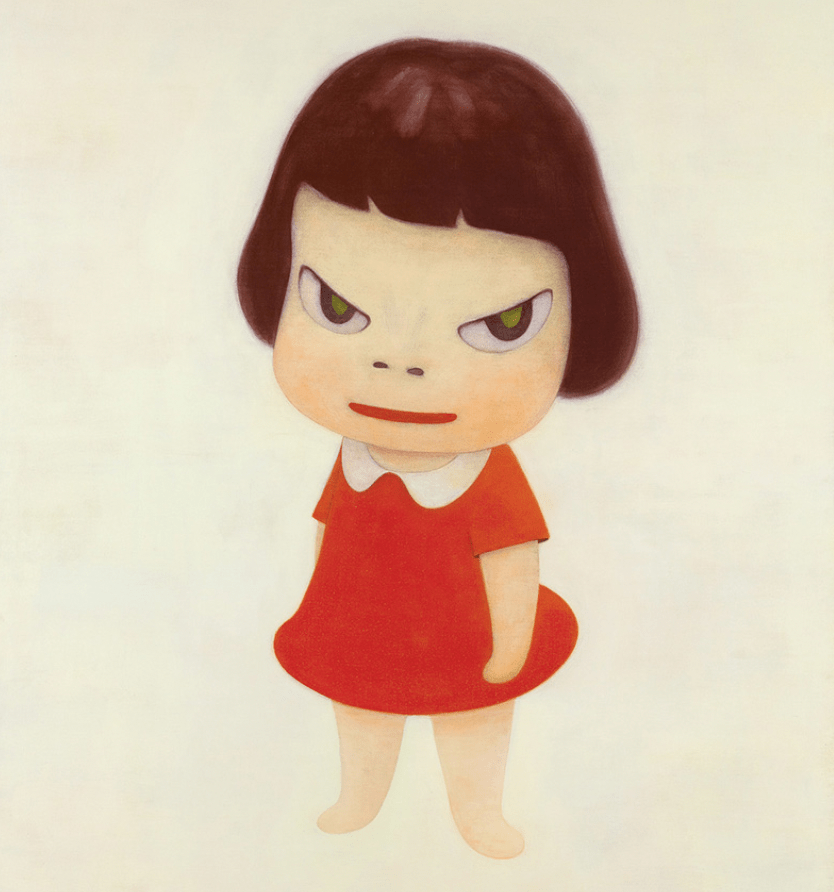
Yoshitomo Nara is the rare artist whose work triggers both “aww” and “uh-oh.” One minute you’re staring at puppy-round eyes; the next you notice the kid is hiding a blade. That dissonance—sweet on the surface, rage under the hood—has made Nara Japan’s most bankable living painter and the unofficial poet-laureate of millennial angst. When his canvas Knife Behind Back (2000) hammered down for roughly US $25 million at Sotheby’s Hong Kong in 2019, he leap-frogged Takashi Murakami to become the country’s auction king. theguardian.comsothebys.com
Origin Story: Snowdrifts, Solitude, and Static-Filled Radio
- Aomori Prefecture, 1959. Long winters, few playmates.
- Solace: manga pages, vinyl sleeves, and the U.S. military’s Far East Network blasting Ramones riffs over snowy orchards.
- 1987: earns an MFA at Aichi University of the Arts.
- 1988 – 2000: Düsseldorf exile. The Kunstakademie offered Joseph Beuys mythos; German punk bars offered cheap beer and even noisier guitars. Both shaped the work. yoshitomonara.org
Nara’s early sketchbooks read like diary entries written in distortion pedals: feral girls, droopy dogs, and slogans scrawled in shaky English. Germany gave him distance from Japan’s visual grammar and license to mash kawaii minimalism with Neo-Expressionist bite.
The Cute/Brutal Dialectic
Knife Behind Back (2000)
Look again at the painting topping this article. The girl’s pupils are as glossy as gumballs, yet her glare could curdle milk. No knife appears—its threat is the title. That invisible weapon is Nara’s masterstroke: violence by implication, delivered through the language of children’s books. The piece riffs on Pop Art’s scale (seven-plus feet tall) but swaps Warholian detachment for raw, personal fury.
Auction houses market it as “iconic.” Critics call it a post-bubble scream. Kids recognize it as the face they pull before hurling a controller. All are right. sothebys.com
Three-Dimensional Rebels
Miss Forest (2016 – 21)
Commissioned by LACMA and now installed on Wilshire Boulevard, this bronze-and-urethane head channels both Bodhisattva calm and evergreen kitsch. The hair spirals upward like a Christmas tree, but the eyes stay hooded—classic Nara ambivalence. The sculpture also marks his shift from studio loner to public-art heavy hitter, trading cardboard scraps for 18-foot monuments. lacma.org
Your Dog (first cast 2002, revisited 2017)
A white fiberglass hound slumps like a beanbag, 6-plus feet long. Children hug it; adults clock the melancholic droop. Nara once said dogs are stand-ins for “powerless beings”—code for himself and, by extension, the viewer. Installed at the Minneapolis Institute of Art, San Francisco’s Asian Art Museum, and dozens of Instagram feeds. collections.artsmia.orgyoshitomonara.org
Light My Fire (2001)
Part sculpture, part stage set: a doll-sized girl sits on a tree stump, lighter in hand, ready to torch comfort. Materials are acrylic, fabric, wood—and pure mischievous intent. It toured Australian museums the year it was made and has since become the go-to image for essays on Nara’s 3-D turn. artnet.compacegallery.com
“Superflat” —with an Asterisk
Nara often gets parked next to Murakami under the Superflat umbrella. The overlap is visual (anime curves, consumer gloss), but philosophically they diverge. Murakami deconstructs otaku capitalism; Nara pipes raw emotion straight onto the canvas. Where Superflat flattens hierarchy, Nara cracks open the hierarchy of feelings: terror, boredom, rebellion, hope—all jostling behind those moon-sized irises. theguardian.com
Houses You Can Walk Into
From his 1993 plywood Pavillon to Pinacoteca 2021, Nara builds shanty-styled huts stuffed with drawings pinned like bedroom posters. The structures echo the ad-hoc clubhouses of childhood, but also nod to Düsseldorf’s Joseph Beuys installations—emotional shelters where viewers complete the work. dreamideamachine.com
Market Math
- 2019: Knife Behind Back sets the record.
- 2020–24: Secondary-market prices stabilize around seven figures, even during pandemic turbulence.
- Main galleries: Blum & Poe (LA/NY/Tokyo) and Pace Gallery (global); both regularly sell out pre-fairs.
The numbers matter less than what they signal: collectors—Asian tycoons and Silicon Valley founders alike—see Nara as the bridge between blue-chip Pop and uncool feelings.
Politics of Tender Rage
Nara isn’t shy about protest. Post-Fukushima, his canvases sprouted anti-nuke slogans; Stop the Bombs (2019) channels childlike handwriting into geopolitical side-eye. His pacifist tweets read like bumper stickers, but the art does the heavy work: empathize first, lecture later. dreamideamachine.com
The Museum Circuit, 2020-25
- LACMA retrospective (2021 – 22) drew 300k visitors despite timed-entry caps. lacma.org
- Albertina Modern, Vienna (2023): showcased 30-plus early drawings, framing Nara as latter-day Egon Schiele (minus the mustache). yoshitomonara.org
- Guggenheim Bilbao → Frieder Burda, Baden-Baden → Hayward Gallery, London touring blockbuster (2024-25) cements his trans-Atlantic stardom. London stop opens June 10, 2025. Book now; merch line will snake to Waterloo. yoshitomonara.com
Critical Reception: From “Dumb Cute” to Canonical
1990s Japanese critics dismissed the work as lowbrow—too cute, too commercial. By the 2020s, the script flipped: scholars link his girls to postwar trauma narratives and his dogs to Shinto animal symbolism. The art-history elevator pitch now reads: Hokusai line work + Disney saccharine + Sex Pistols snarl. That mash-up makes Nara slippery in slide decks, irresistible on mood boards.
Legacy Check
- Visual Ubiquity
His iconography—half-lidded girls, sullen pets—has colonized coffee mugs, Uniqlo tees, and K-pop stage sets. Streetwear drops rarely outshine the originals; the paintings still feel handmade, tender, fallible. - Psychological Honesty
While much of global Pop flips consumer logos, Nara flips inside voices. The work asks: Who wasn’t furious at six years old? - Intergenerational Appeal
Boomers read Cold War anxiety; Gen Z reads meme-ready reaction faces. Few artists ride that age spread without pandering. - Blueprint for Post-Pandemic Public Art
Monument-scale yet intimate, Miss Forest and Your Dog prove sculptures can be selfie magnets and sites of quiet catharsis. Museums hunting for the next crowd-pleaser pay attention.
Final Word
Nara’s genius isn’t that he paints children; it’s that he channels the child still picking scabs inside every adult. The pastel palette lures you close; the radioactive glare keeps you honest. In an era of corporate-approved optimism, his work reminds us that rage and tenderness can share the same small body.
So, when you meet one of his wide-eyed rebels at eye-level, remember: there might be a knife off-screen—and that’s precisely why you can’t look away.

 GLOBAL GRAPHICA