
Modernist Architecture Is Still the Chicest Chaos We’ve Got in 2025
Modernist architecture swaggered onto the scene in the late 19th and early 20th centuries like a design-world anarchist, smashing Victorian frills and Beaux-Arts fluff with a steel-toed boot. It’s all about that pared-down, no-nonsense swagger—clean lines, brutal functionality, and a smug “ornament who?” attitude. Fast-forward to 2025, and this movement’s still got its claws in our cities, suburbs, and avant-garde oddities, a relentless hangover from the industrial boom and tech fetishism that keeps taunting us to dream bigger—and sleeker.
The Origin Story’s a Hot Mess
Modernism didn’t just pop up like a trendy pop-up—it was birthed in the muck of upheaval. The Industrial Revolution tossed steel, glass, and concrete at architects like a DIY kit, while cities ballooned faster than a TikTok trend, screaming for housing solutions that didn’t suck. Cue the heavy hitters: Le Corbusier, Walter Gropius, Ludwig Mies van der Rohe—names that sound like a Euro art clique but delivered buildings that yelled “present tense” louder than a Times Square billboard. Louis Sullivan’s “form follows function” was their chic little manifesto, ditching gaudy facades for spaces that worked hard and looked effortless.
World War I only cranked up the angst, leaving everyone too over-it for gilded nostalgia. Gropius, ever the disruptor, launched the Bauhaus in 1919—a German hothouse where architecture, craft, and tech collided and birthed a revolution. Mass production? Affordable design? The audacity to say good taste isn’t just for the 1%? That’s the vibe that ricocheted from Bauhaus desks to global city grids.

The Look’s a Whole Mood
Spot modernist architecture a mile away: flat roofs, glass walls that practically beg for Instagram, and interiors so open you could host a rave. It’s obsessed with light and air—think Architectural Zoloft for urban gloom. No baroque swirls here, just razor-sharp edges and a palette so muted it’s basically whispering “I’m too cool for color.” Concrete’s left bare, steel beams strut their stuff, and it all oozes a “deal with it” confidence.
Le Corbusier’s Villa Savoye (1929) is the ultimate flex—a pristine white box on skinny stilts that’s basically the architectural equivalent of a Tesla. Those ribbon windows and fluid rooms? Swoon-worthy. Then there’s Mies van der Rohe’s Farnsworth House (1951), a glass shrine so minimal it’s practically meditating. Less is more, darling, and these icons are serving it on a polished platter.
The A-List Players
Modernism didn’t mess around—it went skyscraper-big. The Chrysler Building (1930) in NYC winks at Art Deco but owes its sexy silhouette to modernist guts. The Seagram Building (1958), a Mies-and-Philip Johnson collab, is pure power move—bronze and glass lounging on a plaza like it owns Midtown. Corporate chic, but make it art.
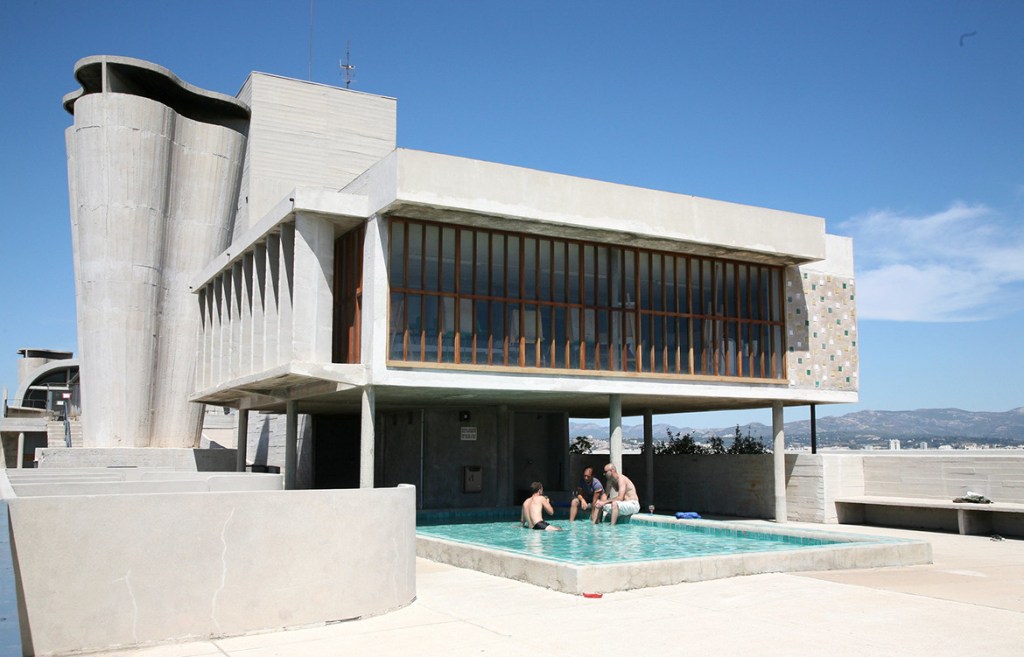
Across the pond, Le Corbusier’s Unité d’Habitation (1952) turned post-war desperation into a concrete playground—apartments, communal zones, and a roof that’s basically a Brutalist Coachella. Frank Lloyd Wright’s Fallingwater (1937) flips the script, draping concrete over a waterfall like nature’s kept man. And Brasília (1960), Brazil’s custom-built capital by Oscar Niemeyer and Lúcio Costa, is modernism’s fever-dream flex—curves and futurism so extra they border on camp.

It Took Over Everything
Modernism didn’t stop at one-offs—it hijacked whole cities. Post-WWII planners chugged the Kool-Aid, chasing shiny utopias. Brasília’s cathedral looks like a UFO touched down in Eden, though haters griped it was more photo-op than livable. Stateside, the Case Study Houses (1945–1966) turned suburbia into a glass-box fantasy, courtesy of Richard Neutra and Charles and Ray Eames, among others. Suddenly, the picket-fence crowd was living in mid-century modern fan fiction.
The Backlash and the Reinvention
By the ‘70s, the shine wore off. Robert Venturi sneered “less is a bore,” kicking off postmodernism’s glitter-bombed tantrum. Mega-projects like St. Louis’s Pruitt-Igoe imploded—literally, dynamited in 1972 after spiraling into a concrete nightmare. Too sterile, too same-y, too “who cares about the humans?”
But modernism’s got nine lives. Brutalism rolled up with its chunky concrete swagger—Louis Kahn’s Salk Institute (1965) and Paul Rudolph’s Yale Art and Architecture Building (1963) are polarizing AF but undeniably bold. Now, Zaha Hadid and Norman Foster are giving it a 21st-century glow-up, all swoopy lines and eco-tech that keeps the faith without the frostbite.
2025: Still Slaying
It’s March 24, 2025, and modernism’s still flexing—Dubai’s spires, Berlin’s lofts, old warehouses reborn as artisanal coffee dens. Sustainability’s the new black, with net-zero builds and retrofits proving it’s not just a pretty facade. Mid-century furniture’s having a moment—Eames chairs are the avocado toast of décor.
Preservationists are in a tizzy, though, battling to save Brutalist babes like London’s Barbican and UCSD’s Geisel Library from the wrecking ball. Are they fugly or fabulous? Jury’s out. Meanwhile, new designs are softening the edges—think modernism meets biophilic coziness. Less “bow down” and more “come hang.”
Why We’re Still Obsessed
Modernism wasn’t just a phase—it was a cultural gut punch. It bet the farm on design saving us all, and left us with skylines, homes, and ideas that still slap. Yeah, it flopped sometimes—soulless blocks, uprooted lives—but those bruises are our crash course in doing better.
In 2025, with climate meltdowns and urban sprawl choking us out, modernism’s lean-and-mean ethos feels like a lifeline with lipstick on. It’s not just concrete and glass—it’s the messy, aspirational souls inside. From Bauhaus to Brasília, Villa Savoye to Seagram, this movement’s still strutting its stuff, whispering: we can build smarter. And honey, we’d better.

 GLOBAL GRAPHICA