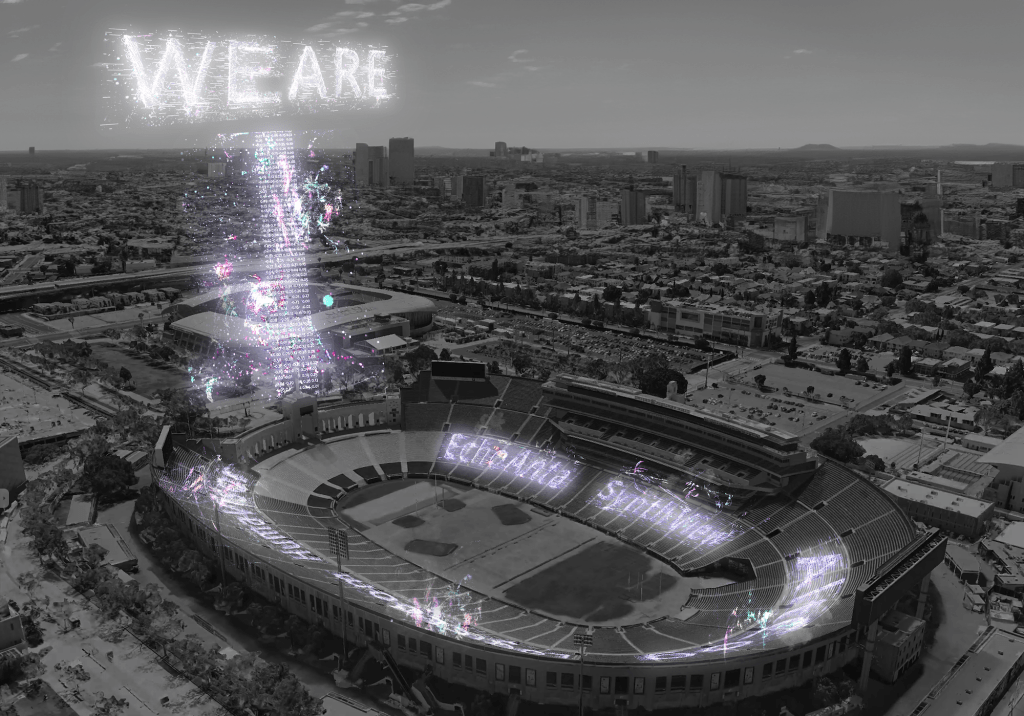
If you were near Exposition Park on the evening of September 15, 2019, you probably heard—or felt—the earth-shattering booms from Cai Guo-Qiang’s latest pyrotechnic spectacle, “WE ARE.” This wasn’t your average fireworks show. It was an avant-garde collision of art, science, and artificial intelligence, kicking off the third edition of “Pacific Standard Time: Art + Science Collide,” a Getty-funded initiative supporting more than 70 themed exhibitions across Southern California.
Cai Guo-Qiang, best known for his gunpowder drawings and large-scale explosion events—including the awe-inspiring pyrotechnics at the 2008 Beijing Olympics—brought his unique blend of beauty and chaos to the Los Angeles Memorial Coliseum. “WE ARE” aimed to probe humanity’s complex relationship with artificial intelligence, infused with the artist’s characteristic flair for the dramatic and the unpredictable.
As dusk settled over the Coliseum, Cai’s narrative began to unfold. Using an AI program to translate his words from Chinese to English, Cai narrated the event in a simulacrum of his own voice, creating a surreal experience that blurred the line between human and machine.
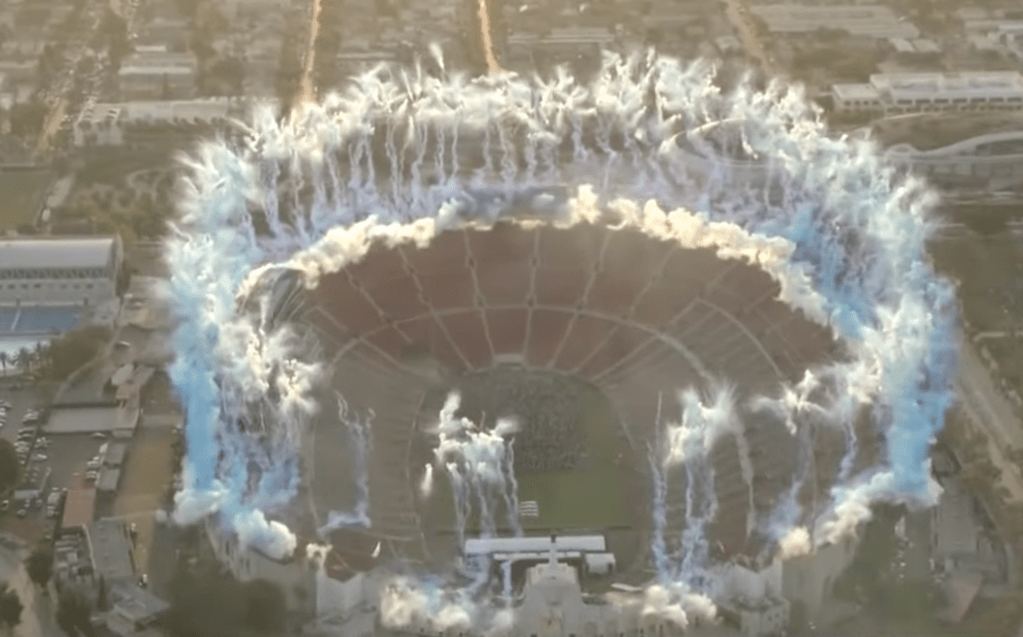
This storytelling set the stage for a series of drone-delivered daytime fireworks and bamboo-fueled explosions, painting the sky in hues of orange, red, and blue. The pyrotechnics softened momentarily to form delicate images of flowers—his “Birds of Paradise”—as a gift to the city of Los Angeles.
But this was only a prelude to the grand finale, “Part V: Divine Wrath.” The spectacle turned visceral, shaking the stadium and its roughly 5,000 spectators with a thunderous set of explosions. Fireworks erupted from all sides, their intensity prompting many attendees to duck or cover their ears.
As ash descended, some improvised with jackets or shirts as makeshift masks against the fallout. The air was thick with tension, amplified by the Coliseum’s proximity to areas historically affected by fires, such as the 1965 Watts Rebellion and the 1992 Los Angeles riots.
The event’s violent crescendo raised questions about its awareness of historical context and the impact on the surrounding community. The juxtaposition was particularly striking given the environmental and socially conscious themes dominating this edition of Pacific Standard Time.
Many participating institutions are focusing on healing the environment and raising awareness of human-made threats. For instance, the Hammer Museum’s “Breath(e): Toward Climate and Social Justice” directly tackles climate change, while other exhibitions explore ecofeminism and Indigenous fire management.
Cai, known for using colored pigments in daytime fireworks to lessen environmental impact, has expressed a preference for these over traditional nighttime displays due to their reduced use of gunpowder. The event organizers noted the use of “organic, sustainable pigments and dyes,” though it’s important to recognize that even these pyrotechnics produce some sulfur and noise pollution.
This introduces an undeniable tension in using fireworks to launch an arts initiative centered on environmentalism. The Getty facilitated this edition of Pacific Standard Time with a thematic focus on art and science but allowed for a degree of independence among the participating institutions.
The result is a heavy emphasis on climate change and environmental themes, with other scientific topics and technological considerations being less represented. “WE ARE” embodies this duality, serving as a spectacular yet jarring reminder of the contradictions we navigate in the intersection of art and science.
Cai’s work provokes and unsettles, compelling us to question our comfort zones. The fireworks were breathtaking, but they carried an inescapable weight—a cacophony of sound and color that left many contemplating the unsettling nature of its message.
As the smoke cleared and attendees exited the Coliseum, one couldn’t help but ponder the lingering question: How do we reconcile the contradictions that arise in our pursuit of celebrating art and science together? “WE ARE” doesn’t offer easy answers, but it certainly makes you think.
If you ever have the opportunity to witness one of Cai Guo-Qiang’s explosive events in the future, seize it—but remember to bring earplugs.

 GLOBAL GRAPHICA